
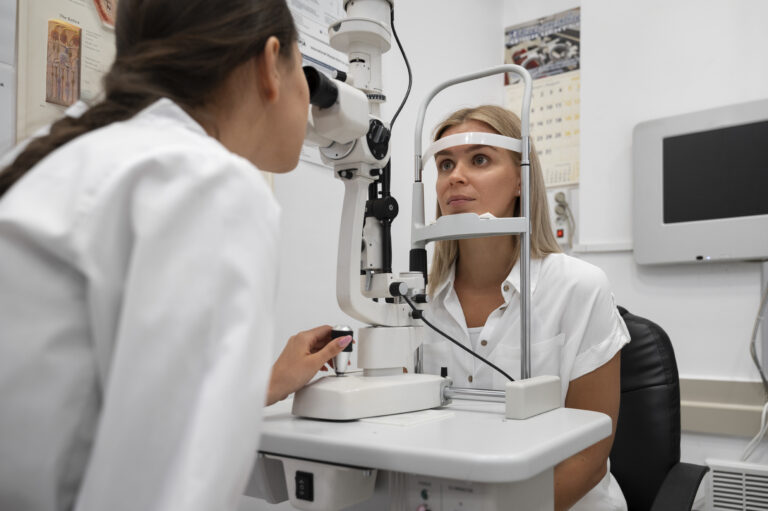
Refractive surgery is currently the most effective procedure for correcting nearsightedness, farsightedness, astigmatism, or presbyopia.
While the precision of modern lasers offers immediate results and rapid vision improvement, another component is equally essential: post-operative follow-up.
Post-operative follow-up plays a major role in the quality of recovery, the stability of results, and long-term visual comfort.
At Phenicia Vision, we consider follow-up to be a true continuation of the surgical procedure, essential for the overall success of the intervention.
Post-operative Follow-up: An Essential Continuation of Care
Ensuring Patient Safety After the Procedure
Immediately after refractive surgery, the eye enters an active healing phase. Follow-up primarily ensures patient safety. Upon leaving the operating room, an initial check verifies the integrity of the corneal flap for LASIK, or the condition of the epithelium after PKR.
In the following days, examinations ensure that the eye is reacting normally, that the eye's surface is reforming correctly, and that the first signs of visual recovery are present.
This regular monitoring helps prevent even minimal risks and ensures a smooth healing process.
Understanding Normal Eye Reactions After LASIK or PKR
Each technique leads to different reactions.
After LASIK, recovery is quick: mild dryness, light sensitivity, and fluctuating vision are normal.
After PKR, the first few days are more sensitive: discomfort, watery eyes, and a foreign body sensation are typical during epithelial regeneration.
Post-operative follow-up helps explain these reactions, reassure the patient, and distinguish between what is normal and what requires special attention.
Quickly Detecting Rare but Possible Complications
Even though refractive surgery has an excellent safety record, certain complications can occur, such as inflammation, flap displacement, or dry eyes…
These are very rare, but they require immediate attention. Scheduled visits allow for early detection and appropriate treatment before any issue affects the final visual quality.
Optimizing Visual Recovery: A Decisive Step
Visual Acuity Progression According to Technique (LASIK, PKR, SMILE)
Visual progression varies depending on the procedure:
— LASIK: Vision improves within the first few hours and continues to stabilize over several weeks.
— PKR: Visual acuity gradually improves over several days, then sharpens over 1 to 3 months.
— SMILE: Rapid recovery similar to LASIK, with less dryness.
Tailored follow-up allows us to assess visual progression, detect normal variations, and guide the patient through the stabilization phases.
The Role of Eye Drops and Anti-inflammatories in Healing
Prescribed treatments (antibiotics, anti-inflammatories, artificial tears) play a fundamental role. Follow-up allows for adjusting dosages, checking for good tolerance, and preventing overuse or missed doses.
Well-managed healing promotes a rapid and lasting result.
Managing Common Symptoms: Dryness, Halos, Gritty Sensation
Post-surgery symptoms are a natural part of laser eye surgery.
Follow-up care helps to:
- Assess eye dryness,
- Monitor the development of night halos,
- Check for any irritation or inflammation,
- Adjust artificial tears or night-time protective measures.
Addressing these symptoms helps improve immediate comfort and optimize visual quality.
Tailoring care to the patient's needs
Personalized follow-up based on the specific vision correction
Each patient has a unique profile: their degree of myopia, corneal thickness, tear film quality, and medical history. Post-operative follow-up allows us to tailor care based on these factors, ensuring the best possible and most individualized recovery.
Adjusting treatment (such as lubricants, anti-inflammatory drops, and screen breaks)
The eye's surface sometimes needs specific adjustments to treatment:
Adding more concentrated lubricants,
Extending the use of anti-inflammatory drops,
Adjusting the frequency of screen breaks,
Advice on exposure to light, wind, or screens.
This personalized support protects the eye during its vulnerable healing phase.
Preventing and relieving post-surgery pain
Especially for PRK, managing pain is crucial. Follow-up ensures that prescribed medications (such as painkillers and soothing eye drops) are effective and that discomfort gradually lessens, providing optimal comfort.
Maximizing the long-term stability of results
Why regular corneal check-ups are important
The cornea continues to stabilize for several months after the procedure. Regular check-ups help verify its smoothness, clarity, and ensure there is no regression.
This leads to clear and lasting vision.
Vision stabilization: timelines and important points to note
Depending on the surgical technique, full vision stabilization can take anywhere from a few weeks to several months. Follow-up ensures precise monitoring of this process and allows us to advise patients on when they can safely resume activities like night driving, sports, travel, and intensive screen use.
Follow-up as a safeguard against vision regression
A slight regression in vision can occur in some patients. If detected early, it can be corrected or managed with appropriate care. Therefore, follow-up acts as a crucial safeguard to preserve the results achieved.
The Central Role of Patient Support at PHENICIA VISION
Reassuring, Informing, and Answering Questions
This follow-up allows patients to understand each step, ask their questions, and experience their journey with complete peace of mind.
Real-time Monitoring and Medical Team Availability
At Phenicia Vision, patients have direct access to the medical team if they have any concerns or unusual sensations. This availability is a cornerstone of post-operative safety.
The Importance of the Patient-Clinic Relationship for a Successful Experience
Good communication builds trust, improves the emotional experience, and directly contributes to the success of the procedure.
A successful operation depends as much on the procedure itself as on the follow-up care.
At Phenicia Vision, we believe that the success of refractive surgery depends on both the precision of the laser procedure and the quality of post-operative care.
This step is essential to maximize safety, optimize recovery, stabilize vision, and ensure a lasting result. Our commitment is to support each patient with thoroughness, availability, and care, from the first consultation to their final vision.