Correction laser des yeux au LASIK à Marseille
Technologie de pointe, résultats durables.

Sécurité maximale

Anesthésie avec collyres

Sans douleur
Récupération express

Intervention rapide et ambulatoire

Équipe performante et disponible
Vous êtes Myope ? Presbyte ? Hypermétrope ? Astigmate ?
Opération LASIK à Marseille
La chirurgie réfractive permet de corriger des troubles visuels tels que la myopie, l’hypermétropie, l’astigmatisme ou la presbytie, en ajustant la forme de la cornée pour offrir une vision claire, sans lunettes ni lentilles. En seulement quelques minutes, vous percevrez une amélioration visuelle et retrouverez une liberté totale.
Opération LASIK : la solution sans douleur
Le LASIK (Laser-Assisted In Situ Keratomileusis) est une technique de correction visuelle au laser utilisée dans notre clinique à Marseille pour traiter efficacement la myopie, l’astigmatisme, l’hypermétropie et certaines formes de presbytie. Cette opération rapide et indolore permet aux patients de retrouver une qualité de vision remarquable, sans dépendance aux lunettes ni aux lentilles.
Reconnue dans le monde entier pour sa fiabilité, cette chirurgie réfractive est particulièrement indiquée pour les patients actifs, qui souhaitent reprendre leurs activités rapidement après l’intervention. Le LASIK est également utilisé comme traitement complémentaire après certaines opérations, comme la cataracte (phacoémulsification), afin d’optimiser la correction finale de la vue.

Examen pré-opératoire offert
Un spécialiste analyse gratuitement votre vue dans notre centre PHENICIA VISION à Marseille pour déterminer si le LASIK, la PKR ou le SMILE peuvent corriger votre vision.
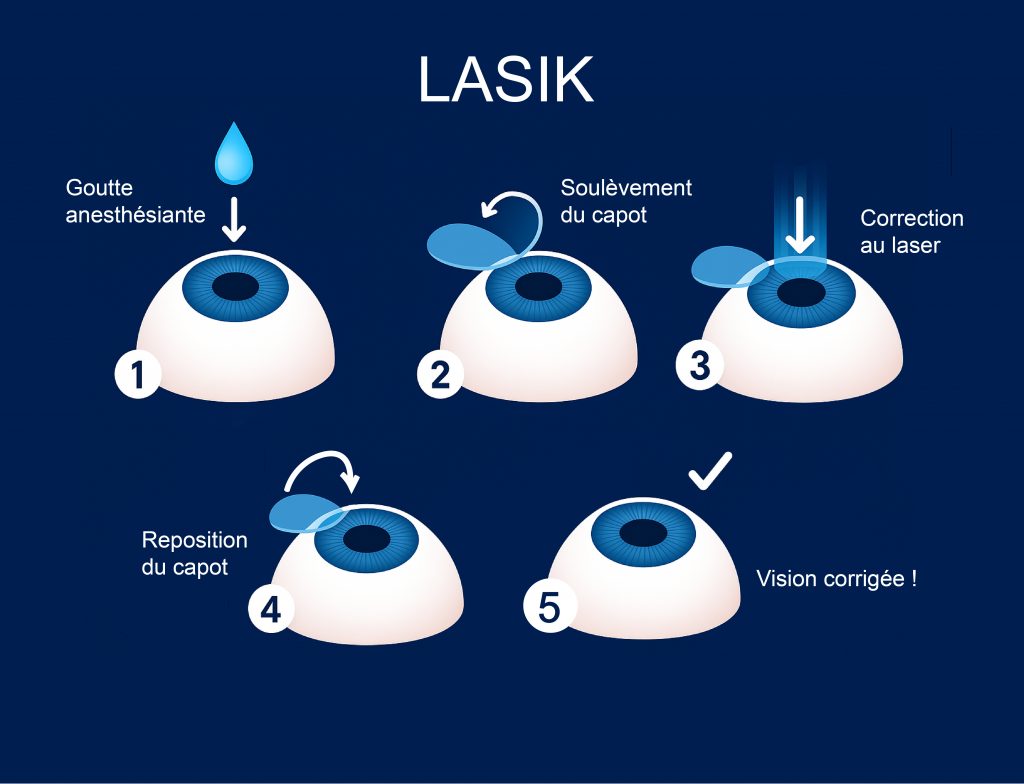
Déroulement de l’intervention LASIK
Seulement 10 min en salle d'opération
1 – Anesthésie locale par gouttes ophtalmiques
Votre œil est insensibilisé grâce à l’application de gouttes anesthésiantes, garantissant une intervention totalement indolore.
2 – Création du volet cornéen avec le Laser Femtoseconde
Vous serez invité à fixer un point lumineux pendant que le chirurgien réalise avec précision un volet cornéen à l’aide du Laser Femtoseconde.
3 – Remodelage de la cornée avec le laser excimer pour une correction précise de la vision
Une fois le volet cornéen soulevé, le Laser Excimer est utilisé pour remodeler la cornée et corriger votre vision.
4 – Repositionnement du volet cornéen
Le volet cornéen est ensuite repositionné pour permettre une cicatrisation naturelle.
Cette procédure est totalement indolore. Elle permet de corriger des troubles comme la presbytie, l’stigmatisme, la myopie ou l’hypermétropie, en une seule opération. Certains patients, ayant déjà subi une opération de la cataracte, choisissent également le LASIK pour peaufiner leur correction visuelle.
Êtes-vous opérable ?
Faites un bilan d’éligibilité dans notre centre pour le découvrir
Bilan d'éligibilité - Laser des yeux
Chaque parcours débute par un bilan ophtalmologique approfondi. Lors de cette consultation, le docteur évalue la santé de votre cornée, votre acuité visuelle et l’ensemble de votre système oculaire.
Ce bilan comprend
- Une évaluation de la vision de près, de loin et intermédiaire
- Une topographie cornéenne et une mesure de la profondeur de champ visuel
- Un examen du cristallin, des antécédents de cataracte, d’autres troubles oculaires
- Une analyse du port prolongé de lentilles ou de lunettes
- Un bilan lacrymal et un bilan oculomoteur
- OCT antérieur et postérieur
- Une rétinographie
- Un fond d’œil
Nos chirurgiens ophtalmologistes prennent le temps d’expliquer en détail la technique chirurgicale LASIK, en fonction de vos besoins et de la santé de vos yeux.
Le LASIK est particulièrement indiqué pour les patients présentant une correction stable, une bonne épaisseur cornéenne et une faible sensibilité à la lumière.
Chaque chirurgien évalue la faisabilité de l’intervention LASIK en tenant compte des spécificités individuelles : forme de la cornée, antécédents médicaux et attentes du patient.
Une clinique à la pointe de la technologie, encadrée par des Ophtalmologues experts
Chez Phenicia Vision, centre de chirurgie réfractive à Marseille, chaque patient est pris en charge par une équipe expérimentée de chirurgiens et de docteurs spécialisés en ophtalmologie. Notre objectif est de vous proposer la meilleure technique de correction adaptée à votre profil visuel.
Notre clinique dispose des dernières innovations en matière de laser femtoseconde et excimer, garantissant une procédure ultra-précise et personnalisée, même en cas d’astigmatisme marqué ou de presbytie débutante. Nous utilisons également un système de reconnaissance irienne et d’eye-tracking pour ajuster la correction en temps réel aux micro-mouvements de l’œil.
Après l'intervention : Une récupération express
- Vision nette en quelques heures.
- Reprise des activités dès le lendemain.
- Suivi post-opératoire à J+1 et J+30 (puis une fois par an) pour s’assurer d’une cicatrisation optimale.
Des résultats durables
- Le LASIK offre une correction visuelle fiable et durable.
- Un taux de satisfaction élevé.
- Une accuité visuelle de 10/10, voir plus, dés les premières semaines.
LASIK, PKR quelle solution pour vous ?
Chaque œil est unique. C’est pourquoi nos docteurs prennent le temps de vous orienter vers la technique la plus adaptée, qu’il s’agisse du LASIK, de la PKR, ou d’un traitement combiné (notamment après une opération de la cataracte).
Le LASIK est souvent recommandé pour sa précision, mais la PKR reste une excellente alternative pour les patients ayant une cornée fine ou des antécédents de chirurgie oculaire.
- ➜ Chirurgie rapide et sans douleur.
- ➜ Technique de correction laser de référence. Elle utilise un laser excimer et femtoseconde.
- ➜ Récupération quasi immédiate.
- ➜ Adaptée aux cornées fines
- ➜ Adaptés aux métiers physiques (pompiers, militaires..) ou sports de contact.
- ➜ Possibilité de faire une TRANSPKR(intervention 100% Laser.
- ➜ Possibilité de traiter la presbytie.
- ➜ Chirurgie rapide et sans douleur.
- ➜ Adaptés aux personnes atteintes de presbytie.
- ➜ Récupération quasi immédiate.
Retrouvez une vision claire et une vraie qualité de vie
Libérez-vous des lunettes et des lentilles, et reprenez pleinement vos activités sans contrainte. Grâce à une correction visuelle sur mesure, vous bénéficiez d’une vision stable, confortable et durable.
Prenez rendez-vous pour une consultation personnalisée dans notre centre à Marseille, et laissez nos docteurs vous accompagner dans votre projet visuel avec bienveillance et expertise.
Chez Phenicia Vision, nous mettons la qualité des soins, l’innovation technologique et l’écoute des patients au cœur de chaque opération.

Bilan offert pour savoir si vous êtes opérable
Nous contrôlons gratuitement votre vue dans notre centre PHENICIA VISION pour déterminer si vous pouvez bénéficier d’une chirurgie réfractive comme le LASIK, la PKR ou le SMILE.
FAQ : LASIK
Qu’est-ce que la chirurgie LASIK
Le LASIK (Laser-Assisted In Situ Keratomileusis) est une technique de chirurgie réfractive au laser qui permet de corriger durablement la myopie, l’astigmatisme, l’hypermétropie, et certaines formes de presbytie. Elle consiste à remodeler la cornée pour que la lumière se focalise correctement sur la rétine, offrant ainsi une vision nette sans lunettes ni lentilles.
En quoi le LASIK est-il différent des autres techniques comme la PKR ?
Contrairement à la PKR, le LASIK implique la création d’un volet cornéen avec un laser femtoseconde, qui est ensuite soulevé pour permettre le remodelage de la cornée avec le laser excimer. Cette technique permet une récupération visuelle très rapide, souvent dès le lendemain, et une reprise rapide des activités. Elle est particulièrement adaptée aux patients à la cornée épaisse et régulière.
Le LASIK est-il douloureux ?
Non. L’intervention est indolore grâce à une anesthésie locale par gouttes. Pendant l’opération, le patient peut ressentir une légère pression ou une gêne temporaire, mais sans douleur.
Qui peut bénéficier du LASIK ?
Le LASIK s’adresse aux patients de plus de 18 ans, avec une correction visuelle stable depuis au moins un an, et présentant une cornée d’épaisseur et de régularité suffisantes. Un bilan ophtalmologique complet est indispensable pour évaluer l’éligibilité. Le LASIK peut également être proposé comme retouche après une chirurgie de la cataracte.
Comment se déroule l’intervention LASIK ?
L’opération dure environ 10 minutes par œil. Elle se déroule en ambulatoire :
- Anesthésie locale par collyres
- Création d’un volet cornéen par laser femtoseconde
- Remodelage de la cornée par laser excimer
- Repositionnement du volet, sans point de suture
Le patient reste éveillé tout au long de la procédure. L’œil est maintenu immobile grâce à un système de suivi des mouvements (eye-tracking).
- Anesthésie locale par collyres
Quelle est la durée de récupération après un LASIK ?
La récupération visuelle est très rapide : la majorité des patients retrouve une vision satisfaisante dès le lendemain. Une amélioration progressive continue les jours suivants. La reprise du travail et des activités courantes est souvent possible dès 24 heures après l’opération, sauf contre-indication spécifique.
Y a-t-il des risques ou contre-indications au LASIK ?
Oui. Certaines pathologies oculaires comme le kératocône, une sécheresse oculaire sévère ou des anomalies cornéennes peuvent contre-indiquer le LASIK. De même, un patient trop jeune ou avec une correction instable ne pourra pas être opéré. Un bilan préopératoire complet est indispensable pour détecter ces situations et proposer une alternative, comme la PKR ou les implants phaques
Quels sont les avantages du LASIK ?
- Correction rapide et durable des troubles visuels
- Procédure indolore et rapide
- Reprise rapide des activités
- Résultats stables et prévisibles
- Technique personnalisée grâce aux lasers de dernière génération
Chez Phenicia Vision, la technologie de pointe (laser femtoseconde, excimer, reconnaissance irienne, eye-tracking) permet d’assurer une précision optimale à chaque étape de l’opération.
Pourquoi choisir Phenicia Vision à Marseille pour un LASIK ?
Notre clinique se distingue par :
- Une équipe de chirurgiens ophtalmologues expérimentés
- Des équipements de dernière génération
- Un parcours patient personnalisé, de la première consultation au suivi post-opératoire
- Un haut niveau de sécurité et d’hygiène
Un accompagnement bienveillant et transparent
Dois-je arrêter de porter mes lentilles avant l’opération ?
Oui, il est recommandé d’arrêter le port des lentilles de contact au moins une semaine avant le bilan pré-opératoire et l’intervention, afin de permettre à la cornée de retrouver sa forme naturelle. Cela garantit des mesures précises de l’œil et assure une meilleure efficacité de la chirurgie.
La chirurgie est-elle prise en charge par la Sécurité sociale ?
Non, la chirurgie réfractive est considérée comme une intervention de confort et n’est donc pas remboursée par la Sécurité sociale. Cependant, certaines mutuelles ou complémentaires santé peuvent proposer des avantages, notamment la prise en charge partielle du prix de l’intervention sous forme de forfait ou de remboursement annuel. Il est donc conseillé de vérifier les conditions de votre contrat avant l’intervention.
Quels sont les risques ou effets secondaires possibles ?
Après l’intervention, certains effets secondaires peuvent survenir de façon temporaire :
- Sécheresse oculaire légère : une sensation de gêne ou de picotement, surtout les premiers jours.
- Sensibilité à la lumière : les yeux peuvent être plus sensibles à l’éclairage naturel ou artificiel.
- Halos lumineux : perception de cercles flous autour des sources de lumière, en particulier la nuit.
Ces effets sont généralement bénins et disparaissent progressivement en quelques semaines, à mesure que ça cicatrise. Un traitement hydratant peut être prescrit pour soulager la sécheresse oculaire, les risques demeurent très faibles.
Comment prendre rendez-vous ?
Il suffit de réserver un bilan ophtalmologique via Doctolib ou en contactant directement un centre spécialisé en chirurgie réfractive. Ce rendez-vous, réalisé avec un optométriste ou un docteur chirurgien en ophtalmologie, permet de mesurer précisément votre correction, d’évaluer la santé globale de vos yeux et de déterminer si votre myopie est bien stabilisée depuis au moins un an.
Si aucune contre-indication n’est détectée (comme une cornée trop fine, un kératocône ou une cataracte débutante) et que vous remplissez les critères d’éligibilité, l’ophtalmologue pourra alors vous proposer une technique opératoire adaptée (LASIK, PKR ou SMILE) et planifier l’intervention. Cette première consultation est essentielle pour garantir une prise en charge personnalisée, sécurisée et conforme à vos besoins visuels et à votre mode de vie. Lors de ce bilan, un devis détaillé vous sera remis, incluant le prix de l’opération selon la technique retenue.
Quels sont les contre-indications de la chirurgie réfractive
La chirurgie réfractive est contre-indiquée dans certains cas, notamment en présence d’une cornée trop fine, d’un kératocône d’un cristallin opaque ou d’une cataracte, car ces conditions peuvent compromettre la sécurité de l’intervention et en réduire l’efficacité. Lorsque ces facteurs sont identifiés lors du bilan pré-opératoire, une alternative adaptée, comme la chirurgie du cristallin, pourra être proposée pour restaurer la qualité de la vue de manière durable.
Est-il possible d’être opéré si j’ai déjà été opéré de la cataracte ou si j’ai des implants ?
Oui, une intervention est parfois possible même après une chirurgie de la cataracte ou en présence d’implants intraoculaires, mais cela dépend du type d’implant posé, de la qualité de la cornée et de la correction visuelle résiduelle. Dans certains cas, une chirurgie réfractive de complément (comme le LASIK ou la PKR) peut être proposée pour affiner la précision de la vue après l’implantation.
Un bilan ophtalmologique approfondi, réalisé par notre docteur chirurgien en ophtalmologie est indispensable pour évaluer la faisabilité et la sécurité de cette correction secondaire, en tenant compte de la stabilité visuelle, de l’état du film lacrymal et de la topographie cornéenne.
La presbytie et la myopie s’opèrent-elles en même temps ?
Oui, dans certains cas, il est possible de corriger la myopie et la presbytie lors d’une même intervention, grâce à des techniques spécifiques comme le presbyLASIK ou la pose d’implants. L’objectif est de permettre une vision nette de loin comme de près, en tenant compte des besoins visuels liés à l’âge. Toutefois, la faisabilité de cette double correction dépend de plusieurs facteurs : l’âge du patient, la stabilité de la myopie, la qualité de la cornée et l’attente visuelle.