What is Myopia?
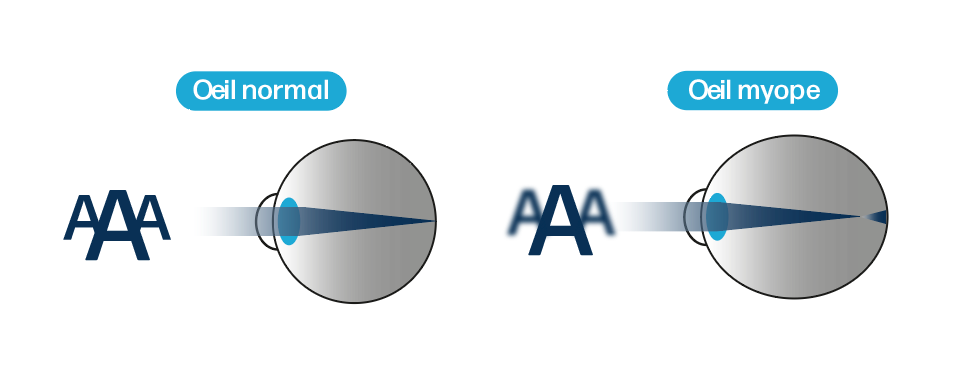
Do you struggle to see things far away? It's highly likely you have myopia. Myopia is a common vision problem where you can see clearly up close, but objects become blurry as they get further away. People with myopia often squint to try and improve their vision, sometimes without even realizing it.
If you recognize yourself in these situations, it might be time to consult an eye care professional at a specialized clinic and consider a suitable solution, whether it's glasses, contact lenses, or refractive surgery. Clear vision can change your life.

What are the symptoms of myopia?
Myopia is a vision problem that causes blurry distance vision, while close-up vision remains clear. It usually happens when the eye is too long or the cornea is too curved, causing light rays to focus in front of the retina instead of directly on it.
As a result, a person with myopia can clearly see nearby objects like a book or a screen but struggles to distinguish distant items, such as road signs, faces from afar, or a classroom whiteboard.
This poor distance vision can lead to eye strain, headaches, and often causes people to squint to try and see more clearly.
Your free eligibility assessment
We welcome you to our refractive surgery center in Marseille to test your eligibility for the procedure for free. This initial assessment is simple, quick, and comes with no obligation.
Surgical techniques to correct myopia

Refractive Surgery
La Laser refractive surgery (LASIK, PKR, or SMILE) is now a modern, safe, and effective solution for permanently correcting astigmatism. It is for people who want to stop wearing glasses or contact lenses, by directly reshaping the cornea to refocus light rays onto the retina.

Intraocular Implants
For older patients or those who already have intraocular implants, other solutions may be considered. A complete eye examination is essential to determine the most suitable procedure for your visual profile and ensure personalized and safe care.
How does the surgeon reshape the cornea during the procedure?
When correcting myopia, the goal is to flatten the cornea to refocus light rays onto the retina. This is done by removing excess corneal tissue from the center using a precision technology called an Excimer or femtosecond laser. This treatment reduces the cornea's excessive curvature, which is characteristic of myopia, and provides lasting improvement in distance vision. The laser primarily targets the central optical zone, where the blurriness is most pronounced, to ensure clear vision without the need for glasses or contact lenses.
Are you eligible for surgery?
Find out if you're eligible by having an assessment at our center.
Our Techniques
Our refractive surgery techniques use advanced technologies, mainly the Excimer laser or femtosecond laser, to precisely reshape the cornea's surface. These precise procedures effectively correct myopia, while ensuring safety and comfort for the patient.
This laser allows us to reshape the cornea to improve how light focuses on the retina, thereby effectively correcting myopia.
There are several types of procedures.
- ➜ Quick and painless surgery.
- ➜ The standard laser correction technique. It uses an excimer and femtosecond laser.
- ➜ Almost immediate recovery.
- ➜ Suitable for thin corneas.
- ➜ Suitable for physically demanding professions (firefighters, military, etc.) or contact sports.
- ➜ Option to perform a TRANSPKR (100% laser procedure).
- ➜ Can treat presbyopia.
- ➜ Quick and painless surgery.
- ➜ Suitable for people with presbyopia.
- ➜ Almost immediate recovery.
Connected generation, myopic generation?
A response to a global trend
The World Health Organization (WHO) predicts that by 2050, nearly 50% of the global population could suffer from myopia. With the increasing use of screens, this phenomenon is becoming a global reality, particularly affecting cities like Marseille, where screen exposure is widespread in professional, educational, and recreational settings. PHENICIA VISION offers a targeted solution to this issue by treating common vision defects such as myopia, hyperopia, astigmatism, and presbyopia through high-precision surgery.
FAQ: MYOPIA
What is myopia?
Myopia is a vision problem that makes it difficult to see distant objects clearly. It occurs when the cornea is too curved, causing the image to focus in front of the retina instead of directly on it.
How do I know if I have myopia?
If you struggle to distinguish road signs, faces from a distance, or TV subtitles, if you often squint to see better, or if you avoid certain activities like night driving or outdoor sports, it's highly likely that you have myopia. This vision problem affects distance vision while leaving close-up vision unaffected.
Does myopia change over time?
Yes, myopia typically appears during adolescence and gradually progresses over the years before stabilizing, usually before the age of 25. For this reason, it's essential to wait until myopia has been stable for at least one year before considering refractive surgery, to ensure a reliable and lasting result.
What are the solutions for correcting myopia?
Refractive surgery allows us to reshape the cornea to refocus images onto the retina, which restores clear distance vision. Unlike glasses or contact lenses, which temporarily correct vision by compensating for the visual defect, surgery has the advantage of acting directly on the eye for a lasting correction. This offers the possibility of being free from daily corrective devices while regaining natural vision quality.
What techniques are offered at PHENICIA VISION in Marseille?
- LASIK: The most common, fast, and effective method, ideal for mild to moderate myopia.
- PRK: A procedure suitable for eyes with thin corneas or for the specific requirements of certain professions and sports.
- SMILE: An innovative technique, particularly recommended for moderate to severe myopia, offering fast and minimally invasive recovery.
Each technique has its own advantages, whether it's fast recovery, precision, or post-operative comfort, to meet the specific needs of patients.
Is the procedure painful?
No, refractive surgery does not require general anesthesia. It is performed under local anesthesia, using anesthetic eye drops applied directly to the eyes, making the procedure painless. The patient remains conscious throughout the procedure but feels no pain. After the operation, some mild discomfort may occur, such as a foreign body sensation, stinging, or light sensitivity, especially in the first few hours. These effects are temporary and generally disappear quickly, allowing for a return to daily life in a very short time, depending on the surgical technique used.
How long does recovery take?
The recovery time after refractive surgery varies depending on the chosen surgical technique, but in all cases, it is relatively fast, allowing a return to normal life in just a few days.
- LASIK: This method, which uses a femtosecond laser, offers fast recovery. Vision improves within the first few hours after the operation, and most patients can return to work the very next day. For sports or more intense physical activities, a waiting period of about one week is recommended to avoid any eye trauma. Rapid recovery is one of the major advantages of this technique.
- PRK: Recovery is a bit longer because this technique works directly on the surface of the cornea. Visual discomfort and pain may be felt for 48 to 72 hours. Vision gradually improves over several days. It is generally possible to return to work after 3 to 5 days, while sports activities should be avoided for about one week.
- SMILE: As the most recent and minimally invasive technique, it allows for an almost immediate return to daily activities. Vision clears within a few hours, with very little post-operative discomfort or pain. Visual comfort and quality of life are quickly restored.
Can myopia and astigmatism be corrected at the same time?
Yes, refractive surgery can treat several vision problems in a single procedure. Farsightedness (hyperopia) and nearsightedness (myopia) are often associated with astigmatism; therefore, a laser procedure can correct multiple vision issues at the same time.
Who can benefit from laser vision correction?
You may be a candidate for surgery if:
You are an adult.
Your prescription has been stable for at least one year (no change greater than 0.50 diopters in the last two years).
You do not have any medical conditions that would prevent the surgery, such as:
keratoconus,
thin cornea,
severe dry eyes,
retinal diseases (e.g., AMD, retinopathy, degeneration),
amblyopia,
uveitis,
glaucoma,
progressive cataract.
Do I need to stop wearing my contact lenses before the surgery?
Yes, it is recommended to stop wearing contact lenses:
- at least 48 hours before the assessment and at least one week before the operation for soft contact lenses,
- 1 week before the assessment and 3 weeks, or even a month, before the procedure for rigid contact lenses, to allow the cornea to return to its natural shape.
This ensures accurate eye measurements and leads to better surgical effectiveness, preventing any over or under correction of the vision defect.
Is the surgery covered by Social Security?
No, refractive surgery is considered an elective procedure and is therefore not reimbursed by Social Security. However, some mutual insurance companies or supplementary health plans may offer benefits, including partial coverage of the cost of the procedure in the form of a package or annual reimbursement. It is therefore advisable to check the terms of your contract before the procedure.
What are the possible risks or side effects?
After the procedure, some temporary side effects may occur:
- Mild dry eyes: a feeling of discomfort or stinging, especially during the first few days.
- Light sensitivity: your eyes may be more sensitive to natural or artificial light.
- Halos: seeing blurry circles around light sources, especially at night.
These effects are generally mild and disappear gradually over a few weeks as the eye heals. A hydrating treatment is systematically prescribed as a preventative measure and can be prescribed to relieve dry eyes; the risks remain very low.
How to book an appointment?
Simply book an ophthalmological assessment via Doctolib or by directly contacting a center specializing in refractive surgery. This appointment, conducted with an optometrist or an ophthalmic surgeon, allows for precise measurement of your vision correction, evaluation of your overall eye health, and determination of whether your myopia has been stable for at least one year.
More specifically, the assessment will allow us to:
The preoperative assessment allows us to:
Measure your visual acuity.
Assess the health of your eyes (cornea, lens, retina, tears, and tear glands).
Examine your eyelids and eye muscles to check for any issues with eye alignment or focusing.
Determine the most suitable surgical technique for your specific needs.
If no contraindications are detected (such as a very thin cornea, keratoconus, or early-stage cataracts) and you meet the eligibility criteria, the ophthalmologist can then suggest an appropriate surgical technique (LASIK, PKR, or SMILE) and schedule the procedure. This initial consultation is crucial to ensure a personalized, safe approach that aligns with your visual needs and lifestyle. During this assessment, you will receive a detailed quote, including the price of the operation based on the chosen technique.
What are the contraindications for refractive surgery?
Here are some situations where refractive surgery is not recommended:
- Cornea that is too thin,
- Progressive eye conditions (keratoconus, glaucoma, advanced cataracts),
- Unstabilized autoimmune diseases,
- Pregnancy or breastfeeding (temporarily),
- Severe untreated dry eye.
In these cases, other options may be suggested by the ophthalmologist to avoid any risk of complications.
Is it possible to have surgery if I've already had cataract surgery or have implants?
Yes, surgery is sometimes possible even after cataract surgery or with intraocular implants, but this depends on the type of implant, the cornea's quality, and any remaining vision correction. In some cases, supplementary refractive surgery (such as LASIK or PKR) may be offered to further improve visual precision after implant placement.
A thorough ophthalmological assessment, performed by our ophthalmic surgeon, is essential to evaluate the feasibility and safety of this secondary correction, taking into account visual stability, the condition of the tear film, and corneal topography.
Can presbyopia and myopia be corrected at the same time?
Yes, in some cases, it is possible to correct both myopia and presbyopia during the same procedure, using specific techniques like presbyLASIK or implant placement. The goal is to achieve clear vision for both near and far, considering age-related visual needs. However, the feasibility of this double correction depends on several factors: the patient's age, the stability of myopia, the quality of the cornea, and visual expectations.
How much does myopia surgery cost, and are there payment options available?
The cost depends on the technique used (LASIK, PRK, or PresbyLASIK) and the type of procedure required. On average, you can expect to pay:
- Between €2,000 and €2,800 for both eyes at Phenicia Vision
- This price generally includes the pre-operative assessment, the surgery, post-operative care, and follow-up consultations.
- Yes, payment in up to 4 installments is available, with an administrative fee.
145 euros administrative fee.
This surgery is not covered by national health insurance, but some private health insurance plans reimburse a portion of the costs (approximately €800 per year, depending on the contract).