
Maximum security
Anesthesia with eye drops

Painless

Express recovery

Rapid response and outpatient treatment

High-performing and available team
Are you nearsighted? Presbyopic? Hyperopic? Astigmatic?
Correct your vision with LASIK
Refractive surgerycan correct vision problems such asnearsightedness,farsightedness,astigmatism, andpresbyopia by adjusting the shape of the cornea to provideclear vision without glasses or contact lenses. In justa few minutes, you will notice an improvement in your visionand regain complete freedom.
LASIK: the pain-free solution
LASIK (Laser-Assisted In Situ Keratomileusis) is a laser vision correction technique used at our clinic in Marseille to effectively treat myopia,astigmatism,hyperopia, and certain forms of presbyopia. This quick and painless procedure allows patients to regain remarkable vision quality without relying on glasses or contact lenses.
Recognized worldwide for its reliability, this refractive surgery is particularly suitable for active patients who wish to resume their activities quickly after the procedure. LASIK is also used as a complementary treatment after certain operations, such as cataract surgery (phacoemulsification), in order tooptimize the final visioncorrection.

Pre-operative examination offered
A specialist will analyze your vision free of charge at our PHENICIA VISION center in Marseille to determine whether LASIK, PRK, or SMILE can correct your vision.
LASIK procedure
Only 10 min in the operating room
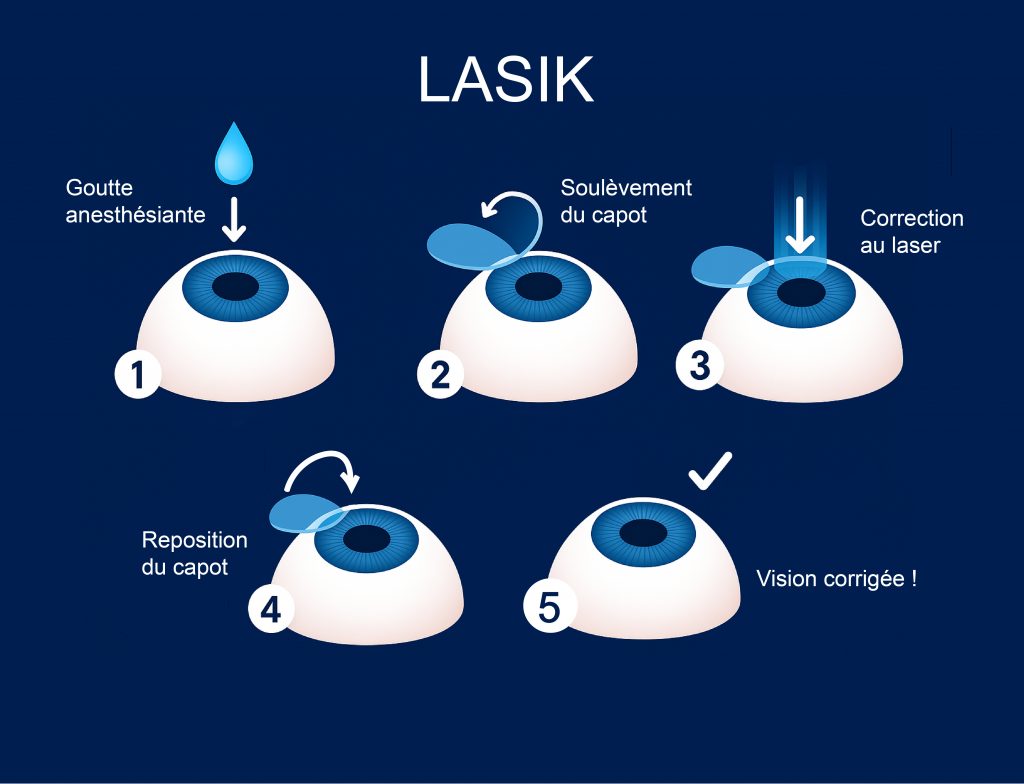
1 – Local anesthesia with eye drops
Your eye is numbed with anesthetic drops, ensuring that the procedure is completely painless.
2 – Creation of the corneal flap using the femtosecond laser
You will be asked to stare at a bright light while the surgeon precisely creates a corneal flap using a femtosecond laser.
3 – Reshaping the cornea with an excimer laser for precise vision correction
Once the corneal flap has been lifted, the excimer laser is used to reshape the cornea and correct your vision.
4 – Repositioning of the corneal flap
The corneal flap is then repositioned to allow natural healing.
This procedure is completely painless. It can correct conditions such as presbyopia, astigmatism, myopia, and hyperopia in a single operation. Some patients who have already undergone cataract surgery also choose LASIK to refine their vision correction.
Are you operable?
Take an eligibility assessment at our center to find out.
Eligibility assessment - Eye laser surgery
Each treatment plan begins with a thorough eye exam. During this consultation, the doctor assesses the health of your cornea, your visual acuity, and your entire ocular system.
This balance sheet includes
- An assessment of near, far, and intermediate vision
- Corneal topography and measurement of visual depth of field
- An examination of the lens, history of cataracts, other eye disorders
- An analysis of prolonged wear of contact lenses or glasses
- A tear assessment and an oculomotor assessment
- Anterior and posterior OCT
- A retinography
- The back of the eye
Our eye surgeons take the time to explain the LASIK surgical technique in detail, based on your needs and the health of your eyes.
LASIK is particularly suitable for patients with stable vision, good corneal thickness, and low sensitivity to light.
Each surgeon assesses the feasibility of LASIK surgery by taking into account individual characteristics: the shape of the cornea, medical history, and the patient's expectations.
A state-of-the-art clinic, supervised by expert ophthalmologists
At Phenicia Vision, refractive surgery center in Marseille, every patient is treated by a experienced of surgeons and doctors specializing in ophthalmology. Our goal is to offer you the best correction technique suited to your visual profile.
Our clinic has the latest innovations in femtosecond laser technology. and and excimerlasers, guaranteeing a ultra-precise and personalized procedure ultra-precise and personalized procedure, even in cases ofmarked astigmatism or presbyopia . We also use an iris recognition and eye-tracking system to adjust the correction in real time to the micro-movements of theeye.
After the procedure: A speedy recovery
- Clear vision in just a few hours.
- Resumption of activities the following day.
- Postoperative follow-up on day 1 and day 30 (then once a year) to ensure optimal healing.
Sustainable results that last
- LASIK offers reliable and long-lasting vision correction.
- A high satisfaction rate.
- Visual acuity of 20/20 or better within the first few weeks.
LASIK, PRK Which solution is right for you?
Each eye is unique. That's why our doctors take the time to guide you toward the most suitable that is best suited to you, whether it be LASIK, PRK, or combined treatment combination treatment (particularly after cataract surgery).
LASIK LASIK is often recommended for its precision, but PRK remains an excellent alternative for patients with a thin corneas or a history of eye surgery.
- ➜ Quick and painless surgery.
- ➜ Leading laser correction technique. It uses an excimer and femtosecond laser.
- ➜ Almost immediate recovery.
- ➜ Suitable for thin corneas
- ➜ Suitable for physical occupations (firefighters, military personnel, etc.) or contact sports.
- ➜ Option to perform a TRANSPKR (100% laser procedure).
- ➜ Possibility of treating presbyopia.
- ➜ Quick and painless surgery.
- ➜ Suitable for people with presbyopia.
- ➜ Almost immediate recovery.
Regain clear vision and a true quality of life
Free yourself from glasses and contact lenses, and fully resume your activities without restriction. Thanks to customized vision correction , you will benefit from stable, comfortable, and long-lasting stable, comfortable, and long-lasting vision.
Schedule an appointment for a consultation in our center in Marseille, and let our doctors guide you through your vision project with kindness and expertise.
At Phenicia Vision, we put quality of care, technological innovation, and listening to patients at the heart of every operation.

Free assessment to determine if you are eligible for surgery
We will check your vision free of charge at our PHENICIA VISION center to determine if you are eligible for refractive surgery such as LASIK, PRK, or SMILE.
FAQ: LASIK
What is LASIK surgery?
LASIK (Laser-Assisted In Situ Keratomileusis) is a laser refractive surgery technique that provides a lasting correction for nearsightedness, astigmatism, farsightedness, and certain forms of presbyopia. It involves reshaping the cornea so that light focuses correctly on the retina, providing clear vision without glasses or contact lenses.
How does LASIK differ from other techniques such as PRK?
Unlike the PKR, LASIK involves creating a corneal flap with a femtosecond laser, which is then lifted to allow the cornea to be reshaped with the excimer laser. This technique allows for very rapid visual recovery, often as early as the next day, and a quick return to normal activities. It is particularly suitable for patients with thick, regular corneas.
Is LASIK painful?
No. The procedure is painless thanks to local anesthesia administered via drops. During the operation, the patient may feel slight pressure or temporary discomfort, but no pain.
Who can benefit from LASIK?
LASIK is intended for patients over the age of 18 who have had stable vision for at least one year and whose corneas are sufficiently thick and regular. A comprehensive eye exam is essential to assess eligibility. LASIK may also be offered as a touch-up after cataract surgery.
How is LASIK surgery performed?
The procedure takes about 10 minutes per eye. It is performed on an outpatient basis:
- Local anesthesia with eye drops
- Creation of a corneal flap using a femtosecond laser
- Excimer laser corneal reshaping
- Repositioning of the flap, without sutures
The patient remains awake throughout the procedure. The eye is kept still using an eye-tracking system.
- Local anesthesia with eye drops
How long is the recovery period after LASIK?
Visual recovery is very rapid : the majority of patients regain satisfactory vision the very next day. A gradual improvement continues over the following days. It is often possible to return to work and normal activities within 24 hours after the operation, unless there are specific contraindications.
Are there any risks or contraindications associated with LASIK?
Yes. Certain eye conditions such as keratoconus, severe dry eye, or corneal abnormalities may contraindicate LASIK. Similarly, patients who are too young or have unstable vision correction will not be eligible for surgery. A complete preoperative assessment is essential to detect these situations and offer an alternative, such as PRK or phakic implants.
What are the advantages of LASIK?
- Quick and lasting correction of visual disorders
- Painless and quick procedure
- Rapid resumption of activities
- Stable and predictable results
- Customized technique using the latest generation of lasers
At Phenicia Vision, cutting-edge technology (femtosecond laser, excimer laser, iris recognition, eye tracking) ensures optimal precision at every stage of the operation.
Why choose Phenicia Vision in Marseille for LASIK?
Our clinic stands out for:
- A team of experienced eye surgeons
- State-of-the-art equipment
- A personalized patient journey, from the initial consultation to post-operative follow-up
- High level of safety and hygiene
Supportive and transparent guidance
Should I stop wearing my contact lenses before the operation?
Yes, it is recommended that you stop wearing contact lenses at least one week before the preoperative assessment and surgery, to allow the cornea to return to its natural shape. This ensures accurate measurements of the eye and greater effectiveness of the surgery.
Is surgery covered by Social Security?
No, refractive surgery is considered a cosmetic procedure and is therefore not covered by Social Security. However, some mutual insurance companies or supplemental health insurance providers may offer benefits, such as partial coverage of the cost of the procedure in the form of a lump sum or annual reimbursement. It is therefore advisable to check the terms of your policy before undergoing the procedure.
What are the possible risks or side effects?
After the procedure, some temporary side effects may occur:
- Mild dry eye: a feeling of discomfort or stinging, especially during the first few days.
- Light sensitivity: Eyes may be more sensitive to natural or artificial lighting.
- Luminous halos: perception of blurred circles around light sources, especially at night.
These effects are generally mild and gradually disappear within a few weeks as the area heals. A moisturizing treatment may be prescribed to relieve dry eyes, but the risks remain very low.
How do I make an appointment?
Simply book an eye exam via Doctolib or by contacting a center specializing in refractive surgery directly. This appointment, conducted by an optometrist or eye surgeon, will accurately measure your prescription, assess the overall health of your eyes, and determine whether your myopia has been stable for at least one year.
If no contraindications are detected (such as a cornea that is too thin, keratoconus, or early cataracts) and you meet the eligibility criteria, the ophthalmologist will then be able to recommend a suitable surgical technique (LASIK, PRK, or SMILE) and schedule the procedure. This initial consultation is essential to ensure personalized, safe care that meets your visual needs and lifestyle. During this assessment, you will be given a detailed quote, including the price of the operation according to the technique chosen.
What are the contraindications for refractive surgery?
Refractive surgery is contraindicated in certain cases, particularly in the presence of a cornea that is too thin, keratoconus, an opaque lens, or cataracts, as these conditions can compromise the safety of the procedure and reduce its effectiveness. When these factors are identified during the preoperative assessment, a suitable alternative, such as lens surgery, may be offered to restore long-term vision quality.
Is it possible to have surgery if I have already had cataract surgery or if I have implants?
Yes, surgery is sometimes possible even after cataract surgery or in the presenceof intraocular implants, but this depends on the type of implant used, the quality of the cornea, and the residual visual correction. In some cases, complementary refractive surgery (such as LASIK or PRK) may be offered to refine the accuracy of vision after implantation.
A thorough ophthalmological examination, carried out by our eye surgeon, is essential to assess the feasibility and safety of this secondary correction, taking into account visual stability, the condition of the tear film, and corneal topography.
Do presbyopia and myopia occur at the same time?
Yes, in some cases, it is possible to correct myopia and presbyopia during the same procedure, using specific techniques such as presbyLASIK or implant placement. The goal is to enable clear vision both far and near, taking into account age-related visual needs. However, the feasibility of this dual correction depends on several factors:the patient's age, the stability of the myopia, the quality of the cornea, and visual expectations.